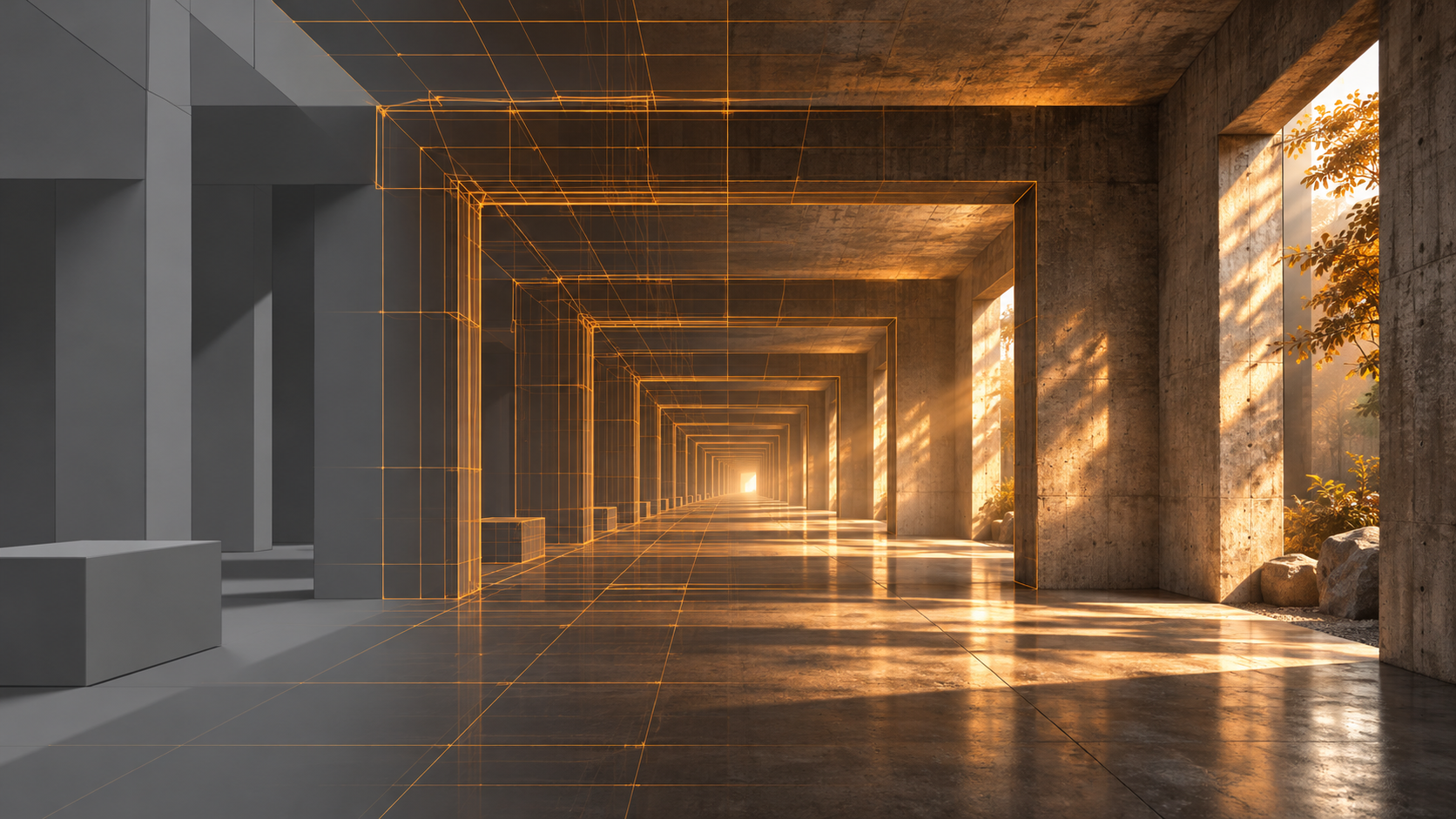
Why the future of AI filmmaking may depend less on generating videos and more on constructing persistent worlds.
The next useful step in AI filmmaking could be a world that survives every render. Geometry, object identity and camera decisions would exist independently of the model producing the final pixels. A director could revise one decision while retaining the others.
The Nexus production case already points in this direction. Grayboxes establish scale and staging; storyboards carry composition; approved frames preserve accepted work. Extending that principle means keeping the environment itself outside the video model.
This is a proposed production architecture, with open research questions. Neural rendering provides a useful starting point, but does not yet establish that a rough blockout can become any desired photorealistic world.
From Shot Control to World Control
A reference frame constrains a generation, but does not fully specify a scene. When the camera turns, the model must still interpret unseen surfaces, object relationships and appearance. A successful shot therefore does not automatically provide a reusable environment.
A persistent world changes what production can retain. A doorway has an identity and position. A machine has authored dimensions. The camera follows an editable path. These decisions become inspectable state, available across shots and revisions.
Consider a corridor with three doors and a damaged service panel. Moving the camera should reveal the same doors in the expected order. Repairing the panel should change that object without redesigning the corridor. Explicit scene state makes those requirements testable, even when the final renderer remains probabilistic.
What DLSS 5 Establishes—and What Remains Open
NVIDIA describes DLSS 5 as a generative rendering stage that complements conventional graphics. Its research overview specifies a rendered frame, engine motion vectors, temporal state and artistic controls as inference conditioning. NVIDIA reports a deterministic process trained for temporal stability.
That is relevant because the engine already supplies an authored scene and its motion. The model works within a rendering pipeline instead of receiving only a verbal description of a shot.
The distinction needs care. This does not mean DLSS 5 directly consumes a complete, editable world description. Nor does it demonstrate that bare gray cubes contain enough information for faithful material synthesis. A finished game frame carries substantial appearance information that a blockout lacks.
Photorealistic demonstrations can motivate the experiment. They cannot establish reliable blockout-to-photorealism, arbitrary fictional materials or continuity across every camera cut. Those require separate evaluation.
A Bridge Between Geometry and Appearance
A gray box specifies volume. It does not establish whether that volume is a concrete wall, a glass partition or a fictional machine casing.
Something has to connect the rough geometry with the intended appearance. Think of it as a hinge between the blockout and the finished image: enough scene guidance to help the renderer understand what the shapes are meant to become, while keeping the underlying layout editable.
In practice, this could mean enriching a blockout with material references and a few clear visual intentions before rendering. The exact implementation can vary. What matters for production is that changing the finish does not require rebuilding the space, and moving the camera does not discard the approved design.
The engine would handle cameras and movement. Neural rendering could contribute surface detail and visual richness, alongside conventional materials and lighting. This is a possible workflow, not a description of the documented DLSS 5 interface.
Appearance also needs persistence. The service panel’s scratches should remain attached to its surface when the camera moves away and returns. That may require textures, procedural coordinates or another persistent appearance representation. Stable geometry alone cannot guarantee stable pixels.
Build Worlds Through Local Construction and Repair
An image could seed the process: identify likely rooms, walls, doors and objects, then construct a provisional scene. But a single view leaves hidden geometry and scale ambiguous. Inferred structure should remain provisional until checked against additional references or author decisions.
The compiler could then enforce explicit requirements: a doorway connects two rooms, a corridor remains traversable, an object fits inside its assigned space. Failed checks would guide local corrections to the scene.
The ambition is incremental construction from verifiable components. A building could be assembled room by room, with shared boundaries checked as components join. Whether this scales economically to complex buildings or cities remains an engineering question.
For fictional objects, explicit geometry offers another benefit: the designer supplies the shape instead of relying on a model to infer it. Appearance remains constrained by the renderer’s capabilities. Unfamiliar optical effects may still need authored shaders or specialized training.
Measure the Creative Feedback Loop
Once constructed, the same environment could support multiple shots and rendering styles. A practical workflow would provide three stages:
- Interactive blockout: Check scale, navigation, blocking and composition.
- Neural preview: Review candidate appearance while checking preservation of scene constraints.
- Production render: Produce accepted imagery through neural rendering, conventional rendering or a combination, followed by postproduction.
The useful measure is time from a specific creative decision to an acceptable, visually verifiable result. That includes failed attempts and review, alongside rendering latency.
Savings are conditional. World construction introduces setup costs; reuse may justify them across many shots. A short, exploratory sequence may favor direct generation. A recurring location with strict continuity offers a stronger case for persistent scene state.
The Experiment Worth Running
Use one corridor, a fixed camera path and progressively richer scene representations:
- Primitive geometry with camera motion.
- Geometry with basic scene guidance and visual references.
- The same scene with material assignments and persistent surface detail.
- A fully authored scene as a reference baseline.
Repeat the camera move, return to a previously seen surface, then change only the service panel. Evaluate geometry preservation, surface continuity, edit isolation, visual quality, latency and total production effort. Include a direct video-generation workflow as a comparison, using the same acceptance criteria.
This would test how much explicit structure is sufficient, and where additional authoring stops paying for itself. It would also distinguish an attractive rendering from a dependable production system.
The World Becomes the Source of Truth
The Production Black Box argues for generative models as bounded operators. A world compiler extends that principle: production owns the environment, and rendering becomes a replaceable stage.
Nexus preserves decisions through grayboxes and accepted frames. A persistent-world workflow would preserve them across objects, shots and sequences. The renderer could change, the style could change, and the camera could change while the authored world remained available for inspection and revision.
That is the research direction: construct worlds whose accepted decisions survive generation, then use neural rendering to make them visible.
Header and tile artwork are conceptual illustrations, not DLSS output or evidence of a working world-compiler pipeline.