
“Research and publish an article” sounds like one assignment. It contains several kinds of work: discovering sources, interpreting claims, drafting prose, validating files, approving a version and changing a public site. Each has a different relationship to uncertainty.
This UniMatrixZ target pattern combines them without giving every stage the same autonomy. It is an architectural proposal based on the site’s production principles, not a claim that this entire runtime is already implemented.
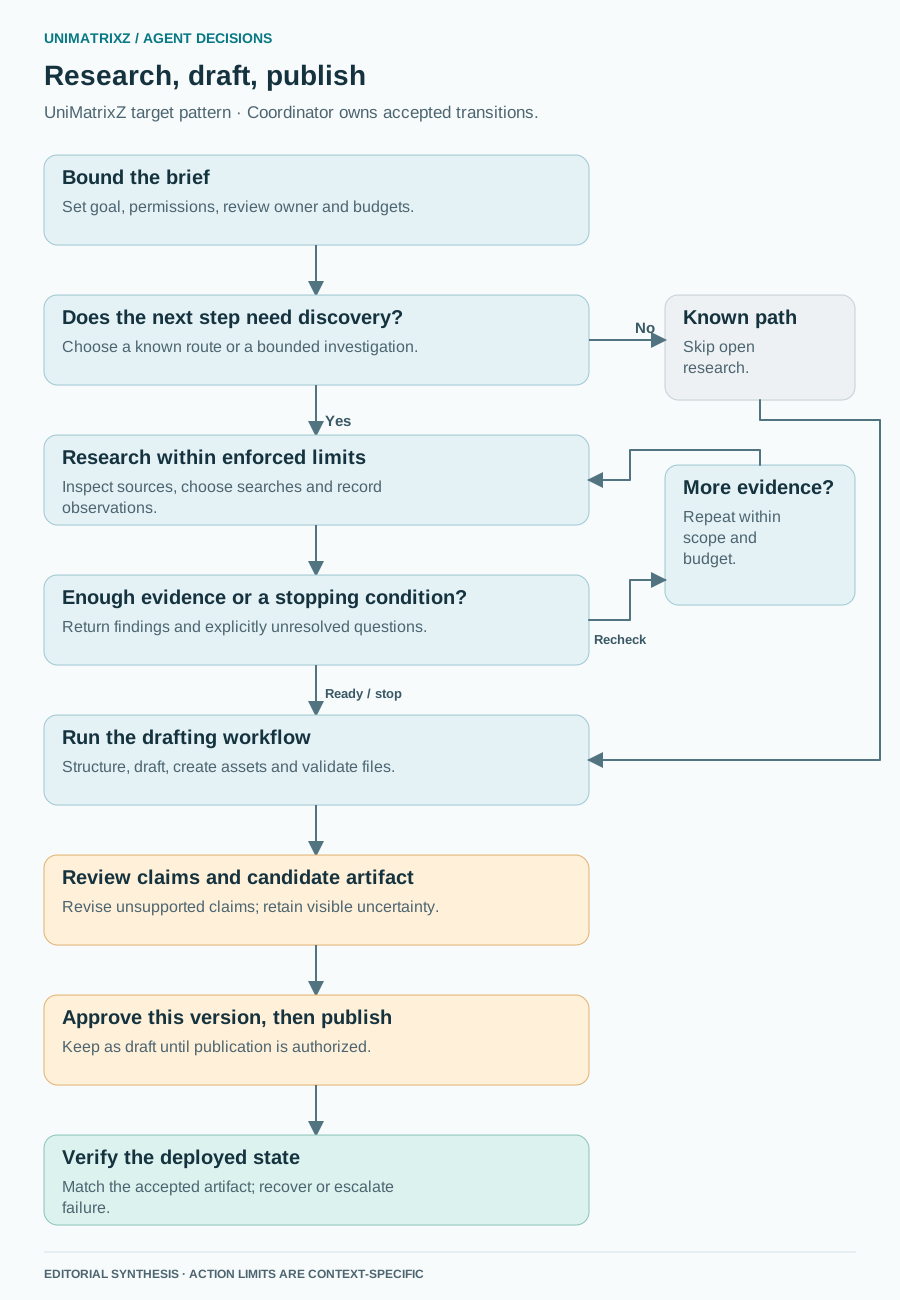
Begin with a Bounded Brief
The brief defines the reader’s question, intended outcome, topic boundaries and acceptance conditions. It also names the publication destination, available source types, research budget and review owner.
For this series, the task could be: explain when an agent adds value, distinguish adaptive reasoning from execution rights and illustrate the distinction with a content workflow. The agent may investigate supporting evidence. It may not silently expand the assignment into product claims, external outreach or unrelated site changes.
A clear brief does not determine every research step. It determines what the investigation is for and what the system may do while pursuing it.
Let Discovery Determine the Research Route
The research stage is a plausible agent candidate. An initial source may reveal a contradictory claim, a missing definition or a useful primary reference. The next search depends on those observations.
Anthropic describes a research system that changes its exploration based on intermediate findings. That supports the architectural case for adaptive research, while its reported resource costs reinforce the need for task value and bounded effort.
Here, the agent returns a small evidence package: claims, supporting passages, source dates, contradictions and unresolved questions. It distinguishes what the source says from the proposed interpretation. A relevant link alone is not sufficient support for every sentence placed next to it.
Research stops when the evidence supports the scoped answer, a defined limit is reached or a human decision is required. The result can include uncertainty. Returning an honest gap is preferable to converting missing evidence into an authoritative statement.
Keep the Known Transformations in a Workflow
Once the evidence package exists, much of the production path is stable. Organize the argument, produce a draft, attach source references, create image assets, integrate the diagrams and validate the content structure.
These steps may use models without becoming an open-ended agent loop. The coordinator can call a model for a draft and then run deterministic checks for required metadata, valid image paths and working internal references.
A failed schema check should normally return to the relevant transformation. It should not trigger unrestricted research. A missing primary source may justify reopening the investigation. Keeping these failure types separate prevents every small defect from becoming a new planning problem.
Treat the Draft as a Candidate Artifact
The draft should remain distinguishable from accepted editorial content. That makes room for comparison, correction and rejection without silently changing the public record.
Review asks whether the argument answers the brief, whether sources support factual statements and whether examples are clearly labeled. In this article, the content-production architecture is a proposed pattern. It must not read like a deployment report.
The diagrams need the same review as prose. A diagram can accidentally imply that human approval overrides missing authorization, or that a passing build establishes factual correctness. The visual route must preserve the intended gates and exceptions.
Creative variation is acceptable within this candidate stage. A different title, visual metaphor or paragraph sequence can satisfy the brief. That freedom does not extend automatically to inventing evidence or removing required review.
Bind Publication Approval to a Version
A person should be able to inspect the actual artifact before approving publication. The accepted version includes the article, images, diagrams, relevant metadata and destination.
If material content changes afterward, the coordinator must decide whether the existing approval still applies. An approval for one article should not become a reusable capability to publish any future revision.
Microsoft’s Magentic-UI offers an example of configurable approval mechanisms for agent actions. In this target pattern, the important design detail is what the approval covers: a concrete change against known state, with visible consequences.
Publish Through a Controlled Path
The publishing step does not need to improvise. It takes the accepted artifact, validates prerequisites and invokes the established release mechanism. Production credentials belong at that boundary rather than in the research context.
Retries also need care. Regenerating a paragraph produces another candidate. Repeating a publication operation may create duplicate releases or overwrite later changes. Before retrying a consequential action, inspect its recorded result and current target state.
A partially completed run should retain enough information to resume or recover. The conversation is useful context, but it should not be the only record of the artifact version, approval or release attempt. Stateful AI Agents explains this distinction between remembered context and authoritative state.
Prove What Reached the Site
A message saying “published” is an assertion to check. Verification should compare the deployed page with the accepted version, confirm that its assets load and record the observed release state.
Anthropic’s evaluation guidance separates the transcript from the final environment state. Applied here, that means inspecting what readers can actually access rather than trusting the publishing tool’s summary alone.
When verification fails, record the discrepancy and use the established recovery or escalation path. Do not mark the task complete just because the draft exists or the build passed.
The resulting system uses freedom where discovery adds value and explicit acceptance where consequences become durable. Research, drafting and publication remain connected parts of one task, with different permissions and different proof obligations.